



Governments across the Middle East have moved from strategy documents to institutional redesign to live deployment — faster than most comparable economies. The story is real. It is also more complicated than the headlines suggest.
National AI strategies have become something of a formality. Nearly every government has published one. Most collect dust. What separates the Gulf from that pattern is not the ambition of the documents — it is what followed them. In roughly five years, the UAE, Saudi Arabia, and their GCC neighbours have rebuilt the institutional architecture of government around AI, committed sovereign capital to owning the compute layer, and moved from pilot programmes to live deployment across public services.
That is the version of the story that gets told, and it is largely accurate. The version that gets less attention is what remains unresolved — and in some cases, unexamined. Both matter if you are trying to form a view that holds up beyond the next investment announcement.

Institutional architecture
Built for speed — which is both the strength and the risk
The most underappreciated aspect of the Gulf’s AI push is that it began with institutional redesign rather than technology procurement. Saudi Arabia’s SDAIA is a cross-cutting coordination body with authority over data governance and AI deployment across all agencies — giving it the ability to move AI from pilot to production without the inter-agency friction that stalls equivalent efforts in most governments. The UAE appointed a Minister of State for AI in 2017, backed that with Federal Law No. 3 of 2024, and has committed $3.54 billion to automate all Abu Dhabi government processes by 2027.
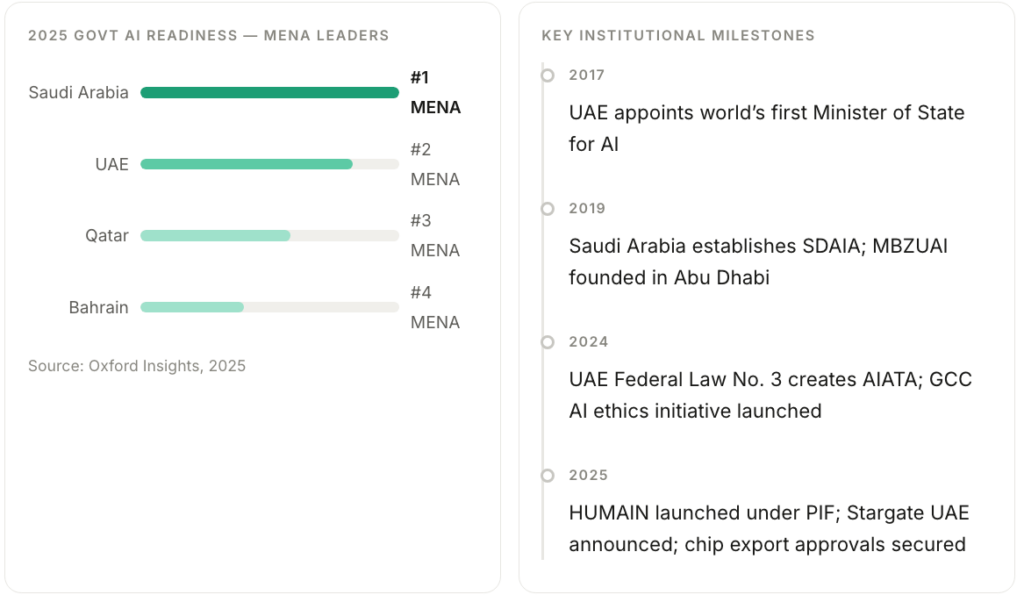
What these structures are optimised for, though, is coordination and speed — not scrutiny. The same design that lets SDAIA move across ministry boundaries also removes the friction that sometimes serves a useful purpose: slowing implementation long enough for questions to be asked. Several Gulf governments have rolled out AI in high-stakes contexts — immigration, healthcare, policing — without public disclosure of how systems were evaluated, what error rates are acceptable, or who bears liability when outcomes are wrong.
Institutions built for speed are not automatically built for accountability. In the Gulf’s top-down model, those two things are in real tension — and the region has not yet fully resolved which takes precedence when they conflict.
Sovereign compute
The infrastructure is being built — but “sovereign” deserves scrutiny
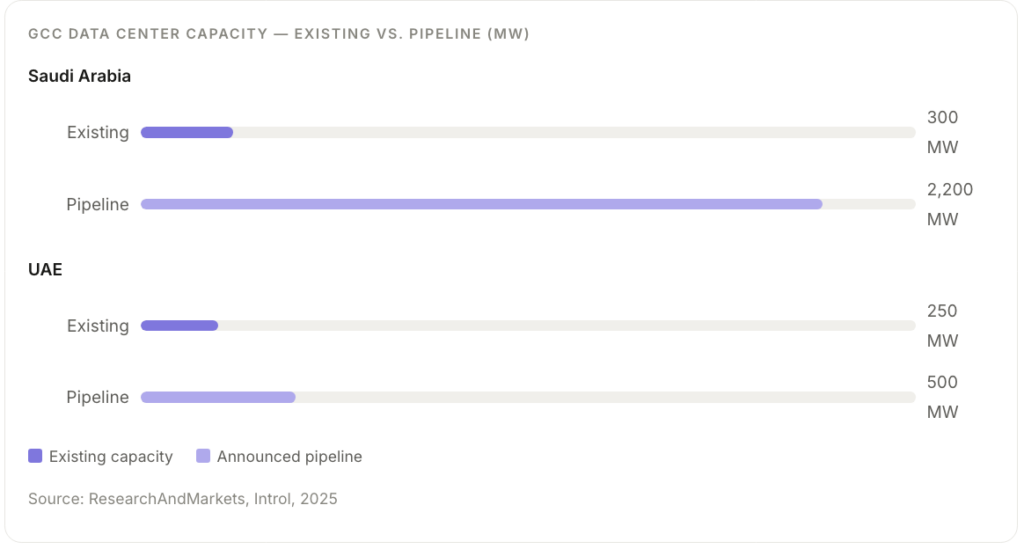
The Gulf’s compute build-out is substantial and documented. Saudi Arabia’s HUMAIN is targeting 500MW of AI factory capacity, with partnerships across Google Cloud ($10B), AWS ($5B), Qualcomm, and xAI. In Abu Dhabi, G42 is constructing Stargate UAE — a planned 5GW campus that would be the largest AI facility outside the United States. Microsoft has committed $15.2 billion to UAE infrastructure through 2029.
There is a coherent logic behind this scale — governments deploying AI in immigration, health, and security need compute within their own jurisdiction. Energy costs in the Gulf are a genuine structural advantage: electricity at $0.05–0.06/kWh versus $0.09–0.15/kWh in the US, a gap that compounds at the scale being contemplated.
What deserves more scrutiny is the word “sovereign.” The Gulf’s AI infrastructure is almost entirely dependent on American chip supply — NVIDIA GPUs, US cloud architecture, US-headquartered partners under US export licences. G42 severed its China relationships in 2023 specifically to stay in good standing with Washington’s export controls. It was a smart bet. It was also a bet — on the consistency of US trade policy across administrations, which is not a guarantee anyone can offer. Infrastructure located within sovereign borders but built on foreign components under foreign licensing is not the same thing as strategic autonomy, and the region’s planners know this even if the press releases do not say it.
- Saudi Arabia’s pipeline of 2,200MW in announced data center capacity dwarfs the UAE’s 500MW — but announced capacity and operational capacity are different numbers, and large infrastructure programmes in the Gulf have a history of timeline slippage.
- The partnership structures — Google–PIF, AWS–HUMAIN, Microsoft–G42 — are joint ventures that create shared upside but also shared control over technology roadmaps and data standards. The capital is Gulf; the technology stack is not.
- Within the GCC, the infrastructure asymmetry is stark: UAE and Saudi Arabia have 30+ data centers each; Bahrain has around five, Kuwait four. A region-wide integrated compute network has been proposed but not built.
Government deployment
Deployment is real — measuring its impact is harder than it looks
Saudi Arabia’s Tawakkalna app — built by SDAIA during COVID to manage health status and movement permits — was a genuine proof point: a government designing, building, and scaling a citizen-facing AI system at national scale within weeks. That institutional muscle has since been applied more broadly. Across the Gulf, AI is operationally active across several public service domains.
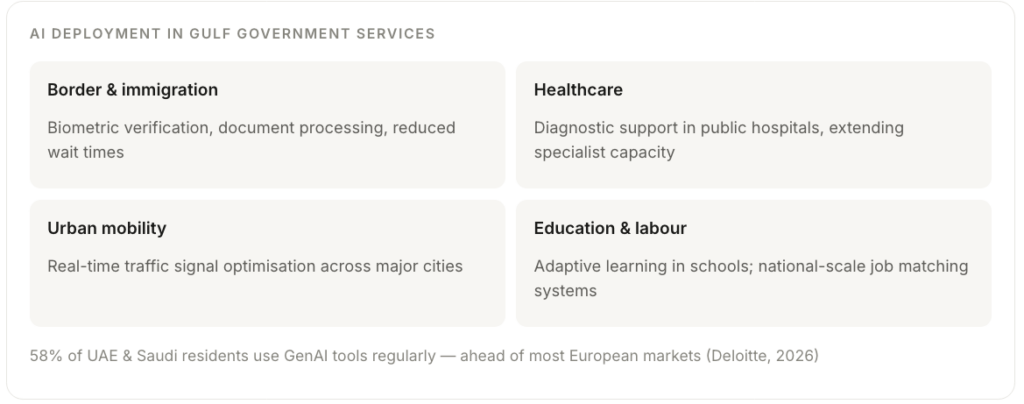
The harder question is what “deployment” actually means in practice. Most Gulf AI announcements describe inputs — systems installed, processes digitised, services automated. What they rarely publish with the same specificity is outcomes: the actual accuracy rates in border biometrics, the clinical quality of diagnostic recommendations, whether labour matching produces better employment results or just a different search interface. Governments that control the narrative around AI rollout also control what gets reported about its performance. That does not mean the systems are failing — but it means external observers cannot confirm they are succeeding, and there is currently no independent audit framework in the region to answer that question either way.
The gap between deployment and impact
Announcing that AI has been deployed in a hospital is not the same as demonstrating that diagnostic outcomes improved. Announcing AI-assisted border processing is not the same as showing reduced error rates. The Gulf’s public reporting is strong on the former and thin on the latter — a pattern common to many governments, but more consequential where independent scrutiny is limited
Models and talent
Real capability — built on a foundation that still needs deepening
MBZUAI — the Mohamed bin Zayed University of AI — is the Gulf’s most credible claim to genuine frontier capability. Founded six years ago in Abu Dhabi, it runs a 40-person lab in Silicon Valley and a team in Paris, producing K2 Think and PAN, a world model for video-based state prediction. It operates essentially as a state-funded AI lab: no teaching requirement, industry-level compensation, frontier research as the mandate. HUMAIN’s parallel push to build Arabic-language LLMs addresses a real equity gap — frontier models are overwhelmingly English-optimised, which matters acutely when Arabic-speaking citizens access AI-mediated public services.
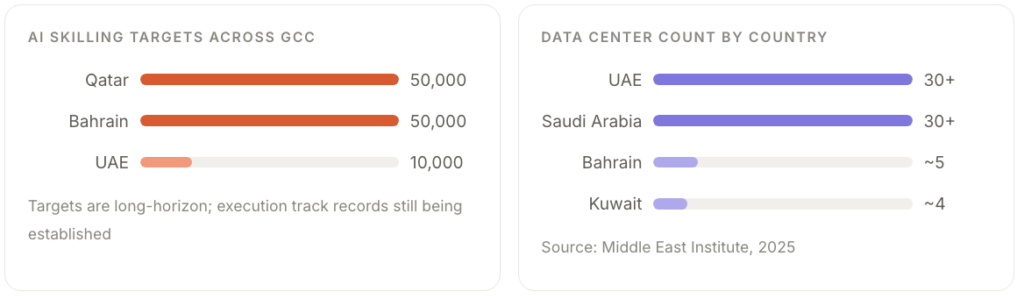
The talent picture, though, requires an honest qualification. The Gulf’s AI research community is predominantly expatriate — recruited internationally, retained by competitive compensation, not structurally rooted in the region. When MBZUAI recruits from Stanford and MIT at sovereign wealth fund-level salaries, it is buying capability in the short term, not growing an ecosystem over the long term. Researchers who can be recruited at that rate can equally be recruited away. The gap between the region’s compute ambition and its indigenous human capital to use it well is real, and it will not close on the timeline of the infrastructure build.
Governance
The frameworks are credible — the accountability loop is incomplete
The Gulf’s governance frameworks are routinely undersold in external commentary. UAE Federal Law No. 3 of 2024 mandates human oversight, decision transparency, and bias detection. Saudi Arabia’s AI Ethics Framework aligns substantively with OECD and UNESCO standards. Bahrain drove GCC-wide ethics harmonisation at the 2024 Global AI Summit in Riyadh. These are real frameworks, not cosmetic ones.
The gap is structural. In pluralistic systems, AI failures surface through investigative journalism, civil society pressure, parliamentary scrutiny, and judicial review. Those mechanisms exist in different forms and with different degrees of independence across the Gulf. When an AI system produces a harmful outcome — a wrongful immigration determination, a flawed clinical recommendation — the path from failure to public knowledge to corrective action is less clear. Technical safeguards are necessary. The institutional architecture of accountability is the work that remains.
Conclusion
Significant progress. Unresolved questions. Both are true.
The Gulf has earned its position in the global AI conversation. The institutional changes are substantive, the infrastructure investments are real, and AI has moved from strategy documents into live government services in ways that would have seemed overstated five years ago. Dismissing this as announcement without substance is a lazy read of what has actually been built.
At the same time, announced capital is not deployed capital. Sovereign infrastructure built on foreign chips under foreign export licences is geopolitically contingent. An expatriate-dependent research community is capability that can be bought — an ecosystem has to be grown. And governance frameworks only work if the institutional mechanisms to enforce them when things go wrong are equally well-designed — which, in the Gulf, they are not yet.
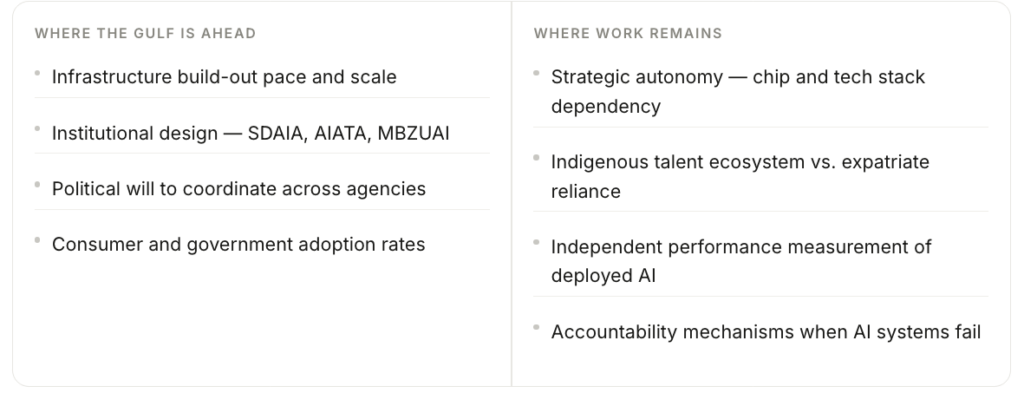
The Gulf is ahead on infrastructure and institutional design. It is behind on the indigenous capability and accountability dimensions that determine whether
those investments compound over time. Neither position is fixed — which is precisely what makes the next five years consequential.
The trajectory will be shaped less by the size of the investments and more by whether the region builds the institutional depth — in talent, in governance, in accountability — that turns infrastructure into durable capability. That is harder work than building a data center, and it is the work still largely ahead of them.
For firms advising across the region: the opportunities are real and the window is open, but so are the structural challenges. Clients who engage with both — rather than the promotional narrative or the sceptical dismissal — will make better decisions and build more credible relationships with government counterparts.