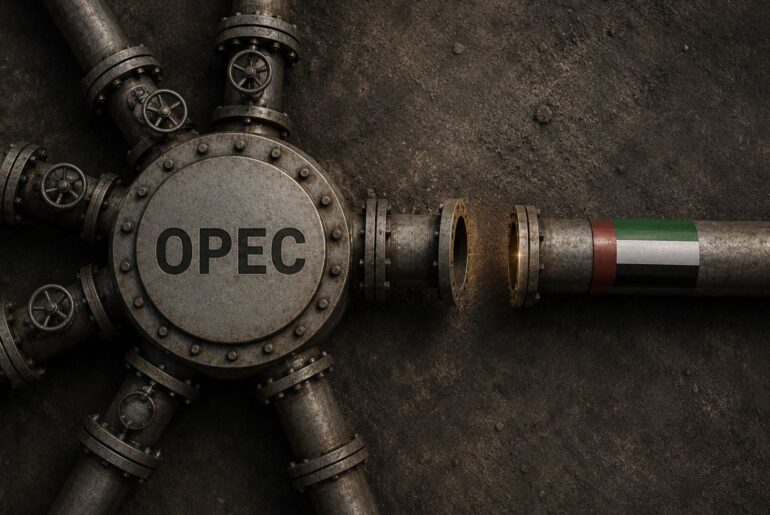



Direct military exchanges between Iran, the US, and Israel have rattled sentiment across Gulf property markets. A closer look at history suggests the story doesn’t end there.
The pause to a long streak
On February 28, 2026, U.S. and Israeli forces launched strikes on Iranian military and nuclear infrastructure. Iran’s response was swift and geographically broad: missile and drone salvos targeted Al Udeid air base in Qatar, installations in the UAE, Bahrain, and Saudi Arabia. Within weeks, the Strait of Hormuz was effectively closed, oil crossed $100 per barrel, and global shipping insurers began halting Gulf transits altogether.
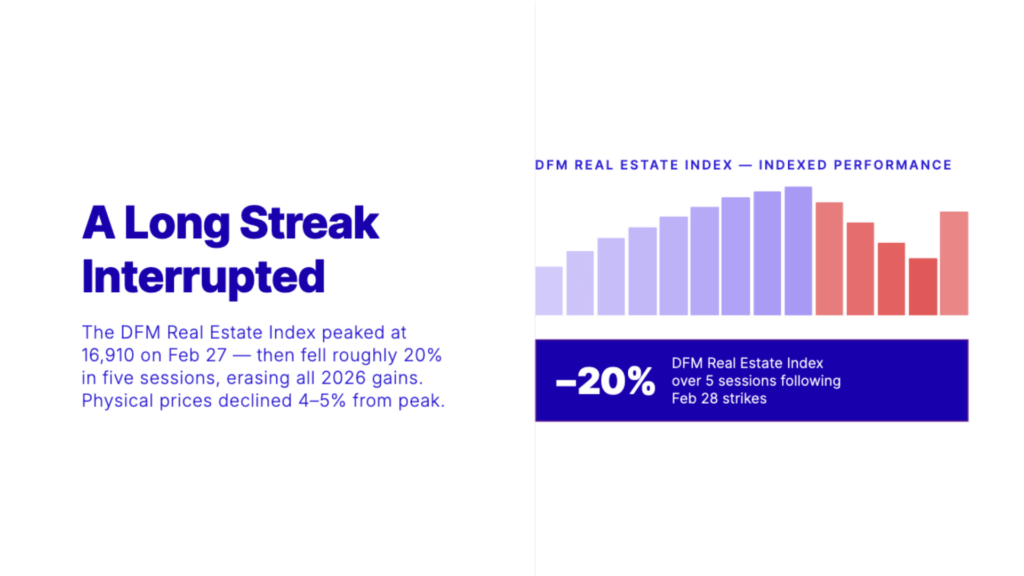
For property markets, the transmission has been immediate and measurable. The DFM Real Estate Index, which had touched a peak of 16,910 on February 27, has fallen roughly 20% in the five sessions since, wiping out all the index’s 2026 gains. On the ground, total property sales registered between late February and March 22 came down sharply from levels normally seen in a comparable window, with physical property prices off approximately 4 to 5% from their recent peak. Sales teams are reporting longer negotiation cycles and more requests for extended payment plans, particularly in high-end off-plan segments that depend heavily on foreign capital.
Between 2022 and early 2025, Dubai prices rose roughly 60%. Abu Dhabi posted 17% annual price growth in the first half of 2025. Bahrain, Qatar, Riyadh – all registered unprecedent growth, breaking all previous records. These were not the mere symptoms of an irrational speculative bubble. They reflected a structural transformation of the Gulf as a destination for global capital – built on low taxes, sovereign-funded megaprojects, and aggressive visa liberalization that had repositioned cities like Dubai and Riyadh as serious long-term wealth hubs.
This foundation has, now, been put to a fierce test. Does the war mark the beginning of a structural reversal, or is it simply another phase in a pattern the Gulf has experienced before? Nothing can’t be said for sure, but this article tries to answer this by analysing historical precedence and understanding what lied in the core of Gulf’s rapid development in the first place.
What the record shows
The Gulf has not encountered geopolitical shock as a novelty. It has encountered it repeatedly – and the pattern that follows is consistent enough to be instructive.
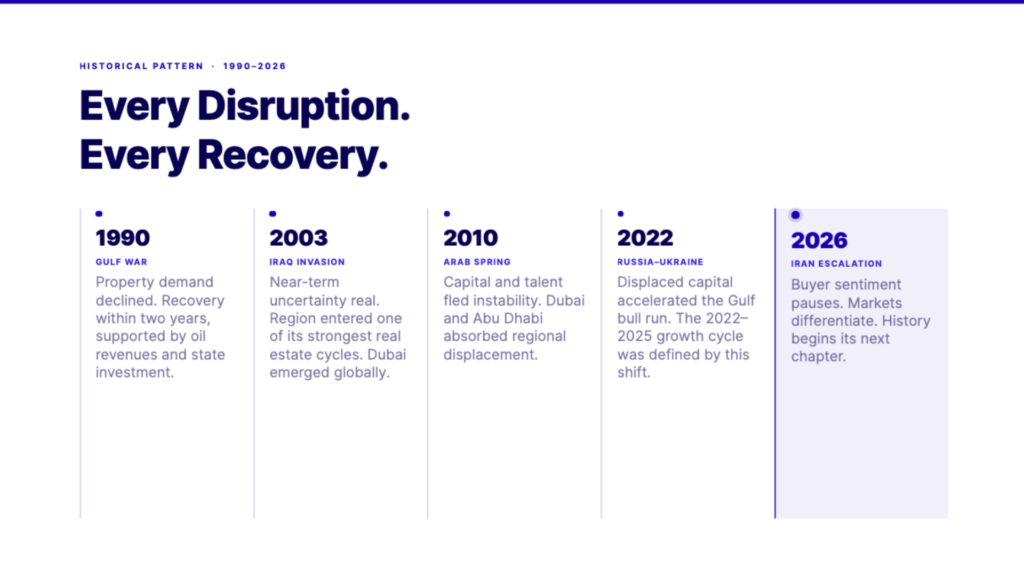
1990 – 1991
Gulf War. Property demand declined across the region. Recovery followed within two years, supported by oil revenues and continued state investment.
2003
US invasion of Iraq. Near-term uncertainty was real. But the region soon entered one of its strongest real estate cycles — with Dubai emerging as a global city of capital.
2010 – 2012
Arab Spring. Political instability spread across North Africa and the Levant. Capital and skilled populations moved toward Gulf cities. Dubai and Abu Dhabi benefited from their relative stability.
2022
Russia–Ukraine war. As capital began flowing out of both Russia and Ukraine, wealthy individuals and investors sought safe, stable destinations. This benefitted Gulf cities – particularly Dubai – accelerating the very growth cycle that defined the 2022–2025 bull run.
2026
Iran-US-Israel escalation. Buyer sentiment pauses. Markets differentiate between durable assets and momentum-dependent ones. History begins its next chapter.
The consistency of this pattern is not coincidental. It reflects a structural reality: when the surrounding region becomes more unstable, cities that offer safety, legal predictability, connectivity, and long-term economic positioning do not become less attractive. They become more so.
Resilience, but not uniformity
None of this means all assets recover equally or at the same pace. The growth phase from 2022 to 2025 attracted an unusually wide spectrum of capital – from long-term institutional investors anchoring positions in prime, well-leased assets to short-term speculative buyers acquiring off-plan units in secondary locations on the assumption that momentum would persist.
The present environment is separating these two groups more clearly than any market commentary could. Assets with strong fundamentals – prime locations, genuine rental demand, long-term utility – are likely to absorb the shock and stabilize. Those that relied on continuous optimism to justify valuations may face a more prolonged correction, and some may not recover quickly.
This is not a flaw in the Gulf’s story. It is a clarification of it. Every major cycle eventually distinguishes between what was built on solid ground and what was built on sentiment. The current conflict has accelerated that reckoning.
“The current conflict is not only a disruption. It is also a moment of differentiation – and that distinction is now central to every serious investment decision in the region.”
The Gulf’s track record does not offer a guarantee. It offers a baseline – a set of prior episodes from which a reasonable person can draw inference. What those episodes consistently show is that recovery has followed every major disruption, supported by policy direction, sovereign capital, and the durable advantages of cities that were built, over decades, to attract and retain global activity.
The question is not whether the Gulf recovers. The evidence on that is fairly clear. The question is which assets recover, on what timeline, and whether the current pause creates entry points that disciplined investors will later recognise as significant.
That is a question worth watching carefully – and answering with precision, not panic.
This analysis is based on publicly available market data and historical precedent. It does not constitute investment advice.