



Regional Intelligence Brief · July 2026 · Monthly Executive Intelligence for the GCC & MENA
This July, two economies are visible at once across the region. One is being built. The other is being tested. What smart leaders are watching, and why the answer is not to choose between them.
Each month, StrategyConnect publishes a Regional Intelligence Brief for the government leaders, sovereign institutions, enterprise executives, investors and independent consultants shaping the GCC and MENA. Not a news roundup. An executive read of the developments that matter most, and the strategic questions they raise.
This perspective comes from within practice, not from the sidelines. StrategyConnect is a network of 7,000+ independent consultants, senior practitioners and subject-matter experts spanning national capability, AI implementation, digital government, industrial policy, sovereign investment, energy transition, logistics and financial services — and many fields beyond, across the Gulf and globally.
The most valuable intelligence often comes from those designing the systems, closing the deals and solving the real problems on the ground — not from those analysing them at a distance.
Two economies are visible across the region this July. One is being built. The other is being tested.
The first is what Gulf capitals now openly call the intelligence economy. Abu Dhabi has rolled out Microsoft Copilot to tens of thousands of civil servants as part of a stated ambition to become the world’s first AI-native government. Saudi Arabia has declared 2026 its “Year of AI” and is standing up hyperscale data centres, including a Tier-IV government cloud in Riyadh. Oman has launched an Arabic large language model and set a 10 percent digital-economy target for 2040. Bahrain is upgrading its financial infrastructure around open banking and digital payments. The pattern is unmistakable. AI is no longer a strategy document. It is being installed as infrastructure.
Alongside rapid advances in AI and digital infrastructure, regional leaders are also navigating a more complex global operating environment. Energy markets, trade routes and geopolitical developments continue to introduce uncertainty into long-term planning. Rather than slowing investment, however, many GCC economies are responding by accelerating efforts to diversify, strengthen institutional resilience, and build future-ready capabilities across technology, infrastructure and advanced industries.
This reflects a broader strategic shift. Governments are no longer treating digital transformation, industrial policy, energy security and economic resilience as separate priorities. Increasingly, these agendas are being pursued together as part of a long-term vision to create more adaptive and competitive economies.
This month’s briefing explores the developments shaping that transition, and the strategic questions leaders should be considering as the region enters the second half of 2026.
The competitive question is shifting from who invests the most, to who can combine technology, institutions and execution most effectively.
Five Signals Executives Shouldn’t Miss This Month
01 — AI is becoming national infrastructure, not a national initiative
Abu Dhabi’s Copilot rollout to civil servants and its stated “AI-native” 2027 target. Saudi Arabia’s “Year of AI 2026” and Tier-IV data-centre programme. Oman’s Arabic LLM effort. What ties them together is not the models. It is the compute, cloud, data and identity layers being installed underneath. Countries that own the platform layer of AI gain long-term optionality that no single application can substitute for.
Watch what is being built underneath. That is where the decade-long advantage compounds.
02 — The megaproject era is being recalibrated, not abandoned
Saudi Arabia’s Public Investment Fund is reallocating capital from long-horizon giga-projects toward near-term returns: Expo 2030, the 2034 World Cup, core infrastructure. Elements of NEOM have been paused or reshaped, with reporting suggesting parts of The Line are being repurposed toward AI and data. This is not a retreat from ambition. It is ambition getting shorter cycle times.
Ambition has not shrunk. Its patience has.
03 — Trade and energy corridors are being stress-tested in real time
Hormuz has partially reopened but at a fraction of pre-conflict flows. Attacks in early July on a Qatari LNG tanker, a Saudi supertanker and another vessel show how fragile the ceasefire is. Qatar’s declared multi-year force majeure on 17 percent of LNG capacity is not a temporary disruption. It is a structural shift in the region’s export architecture. Every board with regional exposure now needs a working plan for another disruption.
Resilience has moved from procurement conversation to boardroom priority.
04 — Capital is becoming more strategic, less thematic
Sovereign wealth funds across the Gulf are increasingly directing capital toward assets that intersect with national capability: AI infrastructure, critical minerals, defensive industrial capacity, energy resilience. The Public Investment Fund’s reported USD 8 billion write-down against earlier giga-projects and its refocus on capital efficiency signal a maturation of the sovereign investment thesis regionally. Less “invest in tomorrow.” More “invest in what secures tomorrow.”
Sovereign capital is increasingly a policy tool, not a returns machine.
05 — Talent has quietly become critical infrastructure
The UAE, Saudi Arabia and Oman have all rolled out or expanded national upskilling programmes this year targeting AI, advanced manufacturing and digital services. This is not employment policy dressed up. The Gulf is competing globally, in real time, for researchers, engineers, AI specialists and industrial expertise. The countries that build absorptive capacity — the ability of institutions and workforces to actually deploy AI once it arrives — will convert their infrastructure spending into economic dividends. The rest will not.
Human capability increasingly determines economic capability. Everything else is a proxy for it.
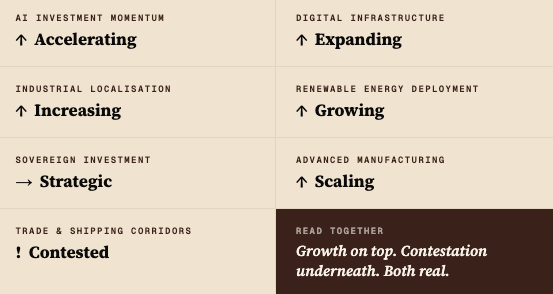
GCC Directional Metrics
Where the region is heading, at a glance.
Directional signals, not GDP. What matters most to a leader is not last quarter’s headline number. It is where the underlying capability is moving.
Three Structural Shifts
The changes worth understanding before the news moves on.
01 — Governments are investing in platforms, not projects
Projects finish. Platforms compound. National cloud, digital identity, sovereign compute, industrial ecosystems, digital payments infrastructure. The Gulf’s most consequential investments this year are not the buildings that get named. They are the substrates being installed underneath every future decision.
02 — Economic security is becoming economic strategy
Food, water, energy, cybersecurity, critical minerals, medical supply. What used to be procurement categories are becoming growth sectors — funded like growth sectors and staffed like them. Resilience is no longer the cost line. It is the strategy.
03 — Execution now depends on ecosystems
Governments, startups, universities, consultants, investors, technology providers. No serious Gulf initiative is executed by a single institution any more. The winners this decade will be the ones who assemble the right ecosystem earliest and coordinate it best. The rest will get outrun by coalitions with the same ambition but faster cycle times.
Across The Region: Nine Countries · July 2026
United Arab Emirates
Frontier government, cooling inflation, quiet leadership.
Abu Dhabi’s June Copilot rollout now covers around 35,000 civil servants, part of a stated ambition to be one of the world’s first AI-native governments by 2027. New cyber, sovereign cloud and AI research capacity is being stood up in parallel, including work centred at Khalifa University and MBZUAI. Dubai’s non-oil economy continues to broaden across trade, tourism and financial services, and inflation has cooled from last year’s peak. ADNOC’s investment in gas and hydrogen positions the UAE for the transition without walking away from its core strength.
The UAE keeps working on the substrate. Others keep announcing on the surface.
Saudi Arabia
The Year of AI, and the year the ambition got sharper.
Saudi Arabia has declared 2026 the “Year of AI.” The framework has been in place for years through SDAIA and the national AI strategy. What is new this year is the hardware layer: Tier-IV government cloud, hyperscale data-centre commitments, global cloud partnerships. Alongside it, the Public Investment Fund is refocusing capital toward Expo 2030, the 2034 World Cup and near-term infrastructure. NEOM has been recalibrated, with some elements paused or reshaped. Non-oil PMI held at strong levels through June, reflecting sustained domestic activity even under OPEC production restraint.
Ambition has not shrunk. It has tightened its delivery timelines.
Qatar
Energy security has replaced energy leadership as the primary story.
QatarEnergy has declared multi-year force majeure covering roughly 17 percent of LNG capacity after strikes earlier in the year sidelined two LNG trains and a GTL unit. The affected capacity is expected to remain offline for a period of three to five years, which is a structural rather than a temporary shift. Doha has moved to accelerate the North Field expansion and downstream helium and pharmaceutical projects to compensate. On the diplomatic side, Qatar was a participant in the June talks that reopened Hormuz. The security calculus around every export decision has changed permanently.
The market Qatar dominates is unchanged. The confidence with which it can deliver is not.
Bahrain
Regulatory innovation as competitive positioning.
Bahrain continues to lean on what it does distinctively: financial-sector regulation and digital-economy positioning. Open banking, digital payments and updated cyber frameworks give the country a specific role in regional financial infrastructure that scale alone would not confer. IMF growth expectations for 2026 remain constructive. Rising oil prices have eased fiscal pressure, and the shift toward solar generation continues to expand. This is small-country strategy done well: leverage what only you can offer, do not compete on volume.
The advantage Bahrain builds is regulatory, not geographic.
Oman
Diversification with deliberate patience.
Oman has moved from planning to build-out. The AI programme under Vision 2040 now includes a dedicated research centre and an Arabic large language model effort. Authorities are targeting a rise in the digital economy’s share of GDP from around two percent today to ten percent by 2040. Major green hydrogen work is progressing with international partners. Duqm Port continues to attract logistics investment as China-Middle East trade flows expand. Oman is doing something quietly rare in the region: pacing itself.
Slower, and probably more sustainable.
Kuwait
Reform-ready, execution-constrained.
Kuwait’s structural challenges remain political rather than economic. Multiple parliamentary dissolutions have slowed major reforms, though core infrastructure projects continue to progress, including the completion phases of Al-Zour and expansion of solar deployment against a 2030 renewable target. Modest growth is projected for 2026. Fiscal balance depends on oil in the USD 80 to 90 range, so recent price movements matter more here than in wealthier neighbours.
The question is not appetite for reform. It is throughput.
Morocco
A private-sector partnership as the growth model.
Morocco is tracking toward around five percent GDP growth in 2026, supported by a strong agricultural year and continued public infrastructure spending including high-speed rail and renewables. In July the World Bank and Rabat announced a ten-year partnership focused on jobs, SMEs and private-sector competitiveness. The shift from investment-led growth to a more dynamic private-sector-driven model is being formalised. Morocco is also positioning itself as an automotive, EV supply-chain and aerospace hub for European export markets.
The country most quietly climbing the industrial value chain.
Egypt
Stabilisation, and the next test of it.
Egypt continues to stabilise under its IMF programme. Growth is projected in the four-to-five-percent range for 2026, with inflation easing gradually. Suez Canal revenues have recovered as shipping normalised, and tourism is returning to strong occupancy levels. Downside risks remain: high public debt sits near 75 percent of GDP, and subsidy reform will test political capital. The mid-year IMF review will signal how far reforms extend into the second half of 2026 and shape investor sentiment for the rest of the year.
Recovery is real. Its durability is the open question.
Jordan
Small country, structural resilience test.
Jordan is expected to sustain around three percent growth in 2026. Regional turbulence has pressured import bills, particularly for energy and food. The fifth IMF programme instalment is expected mid-year and political capacity for further reform is being watched closely. On the upside, Aqaba port expansion, Red Sea oil terminal work and new renewable projects are reducing structural vulnerability. Fitch reaffirmed Jordan’s rating in May, citing steady growth and narrowing deficits. Not a story of scale, but a genuine story of resilience under sustained pressure.
One of the region’s underrated case studies in doing more with less.
Sector Spotlight
The Rise of AI Infrastructure
Data centres, compute, sovereign cloud, digital identity. The layer being installed underneath everything else.
The consequential story in Gulf AI this year is not the applications, however impressive. It is the infrastructure being installed to run them. Saudi Arabia is converting its energy advantage into digital advantage by financing hyperscale data centres and courting the major cloud operators to host regional capacity. Abu Dhabi is standing up sovereign cloud alongside its Copilot deployment. Oman’s AI research centre and language-model work require compute that did not exist domestically two years ago. Bahrain’s financial infrastructure upgrades depend on the same substrate.
The strategic significance is easy to miss because infrastructure is invisible by design. But the countries that own compute, cloud and identity domestically will have optionality that others must rent. The countries that do not will be dependent on the platform decisions of foreign providers whose priorities may not remain aligned. Critical-mineral capacity to feed chip supply becomes a second-order concern with real strategic weight.
For executives this creates two immediate questions. First, where should compute-heavy operations sit given the new regional capacity coming online? Second, how does cybersecurity, data governance and regulatory alignment need to catch up with the pace of the build?
The takeaway: The Gulf is not just adopting AI. It is building the platform layer on which the region’s next economy will run. That is a very different competitive position.
Three Things Worth Watching
What could move next.
01 — Whether the Hormuz ceasefire holds through Q3
The June truce is still the only structural reason global energy flows are anything close to normal. Watch for concrete progress from talks in July or a return of large-scale attacks. Either outcome triggers major reallocation decisions in shipping, insurance and inventory.
02 — The October OPEC+ meeting, and what it signals about Iranian supply
Gulf producers are unlikely to expand output until they have visibility on how durable the Iranian supply picture is. Any signal from October will feed straight into 2027 fiscal planning across the region. Brent below USD 80 pressures stimulus projects. Above USD 100 gives sovereign capital more room to manoeuvre.
03 — Regional AI regulation catching up with regional AI deployment
The UAE is drafting AI liability and privacy frameworks. Bahrain has updated cyber regulation. Expect the wider GCC to move toward coordinated digital-governance standards, potentially via the Gulf Secretariat. The organisations that align early will find deployment smoother than those that hedge.
Strategic Questions For Decision-Makers
- Are our AI initiatives creating institutional capability, or simply automating existing processes?
- Which of our supply chains remain materially exposed to disruption, and what would a practical diversification strategy require?
- Are we investing in the talent needed to absorb AI at the same pace we are investing in the technology itself?
- Where can public-private collaboration most effectively accelerate delivery over the next twelve months?
- Which sectors are likely to attract the next wave of strategic and sovereign investment, and are we positioned to benefit?
- How resilient are our critical operations to geopolitical, economic or supply-chain disruptions, and have we tested our response capabilities?
- Which emerging digital and AI infrastructure across the region could create new opportunities for collaboration, innovation or operational efficiency?
- Are we prepared for the next generation of AI governance, digital regulation and data policy emerging across the GCC?
- Which emerging sectors and technologies are creating the greatest opportunities for long-term growth, and how can we participate early?
- Looking toward 2030, which capabilities should we begin building today to remain competitive in an increasingly intelligence-driven regional economy?
July reinforces an important shift across the region. Competitive advantage is becoming less about individual technologies and more about how governments and organisations connect policy, capital, infrastructure and talent into coherent systems.
The organisations that thrive will not be those adopting the newest tools first. They will be those that consistently translate strategic ambition into institutional capability.
7,000+ experts across government, AI, sovereign investment & beyond
StrategyConnect brings together over 7,000 independent consultants, senior practitioners and subject-matter experts across national capability, AI implementation, digital government, industrial policy, sovereign investment, energy transition, logistics, financial services and public-sector strategy — and many fields beyond — creating one of the Gulf region’s most connected intelligence networks.
Have an upcoming priority? Whether it’s shaping an AI strategy, building supply-chain resilience, stress-testing a sovereign investment thesis, or starting an important conversation — we’d like to hear from you.
This article was developed by the StrategyConnect team, leveraging AI tools to support research and content development, with internal review and refinement to ensure quality and relevance.